
Slop Was Here Before AI
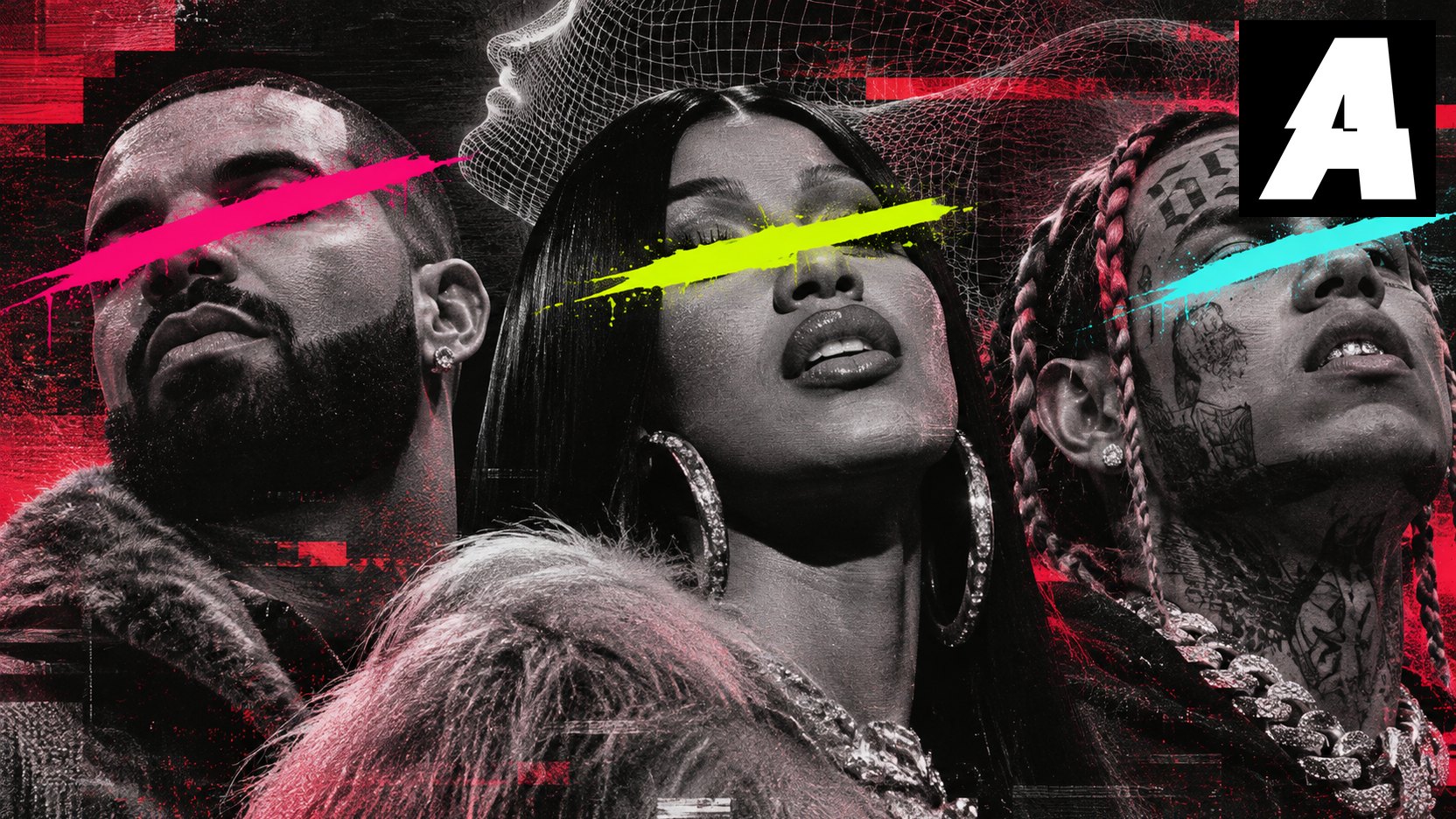
Rap fans are hunting for AI fingerprints in every hook, but mainstream hip hop was running on presets long before Suno showed up. The tools aren't the problem. The talent shortage is.
By Jay Robinson | Sat, Nov 14, 2026
Put a pair of studio monitors on most of what’s charting in rap right now and solo the drums. Same 808 slide pitched to the same key. Same rattling hi-hat triplets copied off the same YouTube tutorial. Same vocal chain, same autotune retune speed, same melodic mumble floating over the same minor-key loop pack everybody bought on the same Black Friday sale. Nobody needed a neural network to make that music sound machine-made. The industry got there on its own.
That’s what kept running through my head while I watched Ai Music Is Taking Over Hip-Hop (Suno, Udio Explained), a 22-minute breakdown from the small channel jakerolz18. It walks through four records, each one harder to prove than the last, and treats the whole thing like a crime scene. It’s well researched and worth your time. I just think it’s investigating the wrong crime.
The case files
The first case is Fenix Flexin’s “Rubberz,” the faux-Morrissey synth-pop record that climbed to No. 58 on the Billboard Hot 100 this summer. The producer Medasin found the suffix “Sonauto.mp3” on a file name in one of Fenix’s own pre-release clips. Sonauto was the old name of the AI music app Treblo, which rebranded two days before the song came out. Fenix denied it for months, said on Hot 97 there was “no AI on it,” then posted stems as proof. Medasin showed how any stem splitter can pull a finished AI track apart, and the clips came down. Then Treblo released its own detector, which called the song “very likely Treblo,” and its co-founder said someone “appears to have used our model to find a sound that millions of people connected with.” Fenix finally wrote on Instagram that he “never said I didn’t use AI” and told everyone to “keep up w the times or get left behind.”
Then came Tyga’s ’80s concept album $TARFACE. He told People the record was built on vintage hardware, then told Vibe a week later that “we definitely used AI as a [tool]” for some synths and a guitar solo, while “the writing, all the vocals are all me.” Pitchfork gave it a 0.0, its first zero for a new album in about two decades. Even that review stopped short of calling the album AI. The critic said only that he was “personally able to generate a song that sounded exactly like” it.
The video closes on Ye and Playboi Carti. Ye said in February 2025 that he was using AI versions of his own voice, then wrote “no AI” on the Bully tracklist this March. An anonymous producer is now suing him, saying he built “at least 13 custom AI voice models” and “more than 400 individual vocal generations” for Vultures 2 and Bully. With Carti, fans are passing around spectrogram screenshots of a baby voice he’s been doing since long before any model could fake it, and nobody has real proof either way.
Everybody is using the same tools
Here’s what the forensics crowd won’t admit. The people throwing “fake studio craft” at every new record are working out of the same toolbox. Pre-made loop kits. Type beats bought off a marketplace. Pitch correction locked to the scale. Drum samples that ten thousand other producers own. Session vocalists, ghostwriters and reference tracks. Hip hop has always been built on borrowed signal. That was the whole genius of the sampler. As I wrote about Dr. Dre’s take on AI, the tool only exposes the hand holding it.
So the outrage is selective. A rapper who buys a $30 drum kit, a $50 type beat and a vocal preset is “authentic.” A rapper who prompts a guitar solo is a fraud. Both of them skipped the part where they learned to play the guitar. The real question was never which button you pushed. It’s whether what comes out the other end is any good.
And by that standard, most of the mainstream was already failing. You can’t tell the AI tracks from the human ones anymore. Deezer and Ipsos played blind tests for 9,000 people across eight countries, and 97% couldn’t correctly identify all three tracks. Everybody quotes that as proof the machines got scary good. I hear something else in it. A lot of human-made music was already so formulaic that a model trained on it can’t be told apart from it. That isn’t AI slop. It’s slop that came first, and the AI learned it from us.
Thirty years of the same record
Be honest about the last three decades of mainstream rap. Sounds have rotated, from jiggy to crunk to ringtone rap to trap to drill, but the formula underneath kept getting narrower. The hook goes here, the flex goes here, the feature goes here, and the whole thing gets cut to fit a playlist.
The people who actually broke the mold are few enough to count on one hand. Eminem turned multisyllabic rhyme into something closer to engineering, stacking internal rhymes and switching cadence mid-bar in ways people are still pulling apart. Kanye West’s My Beautiful Dark Twisted Fantasy in 2010 went the other direction and blew the walls out of the room. It was maximalist and genre-bending, with prog rock, soul, orchestral strings and a rap album’s swagger all at once. “Power” is built on a sample of King Crimson’s “21st Century Schizoid Man.” “Dark Fantasy” opens with Nicki Minaj reworking a Roald Dahl poem. “Runaway” came with its own short film. Pitchfork gave it a 10.0, and it won Best Rap Album at the 2012 Grammys. Joyner Lucas made “I’m Not Racist” in 2017, a song built as a two-sided argument that made the whole internet sit with something uncomfortable, and then held his own next to Eminem on “Lucky You.” Their work does things the formula doesn’t. That’s why nobody mistakes them for a preset.
Outside of that handful, the genre has been running on formula.
The numbers say the flood isn’t winning
The scary stats are real. According to Deezer, fully AI-generated tracks passed 50% of its daily uploads at peak in June, or about 90,000 tracks a day. Suno raised over $400 million at a $5.4 billion valuation this summer, after passing 2 million paying subscribers. The labels that sued Suno and Udio in 2024 are now signing deals with them. Warner settled with Suno, Universal settled with Udio, and Universal and Sony are still fighting Suno in court.
But read the next line of Deezer’s report. All that AI music adds up to just 1 to 3% of what people actually stream, and up to 85% of those streams were fraudulent in 2025. The flood is mostly bots farming pennies. When nobody behind a prompt has anything to say, people don’t listen. $TARFACE got a zero. “Rubberz” was a hit, but the story everyone tells about it is a cover-up, not a great song.
That’s the part the panic misses. AI didn’t lower the bar, it showed where the bar already was. Typing a sentence and getting a song back is the easy part now. Nobody gets paid for easy anymore.
So who’s good enough
That’s the real test the video kept circling without naming. Suno, Udio and Treblo can make a polished, forgettable hook in ten seconds, which means a polished, forgettable hook is now worth nothing. What’s left is the stuff no model can come up with alone: a point of view, a story only you could tell, a flow that makes another rapper rewind it, a beat flipped somewhere the training data never went.
The rappers attacking every new record with “it’s AI” usually have the least to lose from AI and the most to lose from honesty. Use the tool or don’t. Prompt the guitar solo, chop it, run it back through the SP, write sixteen bars over it nobody else could write. Just make something that hits like the first time you heard “I’m Not Racist,” the first time the “Power” chant came out of a car speaker, or the first time you heard Marshall’s voice.
The machine is open to everybody now. Same tools, same price, same starting line. So let’s see who’s actually good enough to make hip hop better.
AdSense/Ad Spot Placeholder